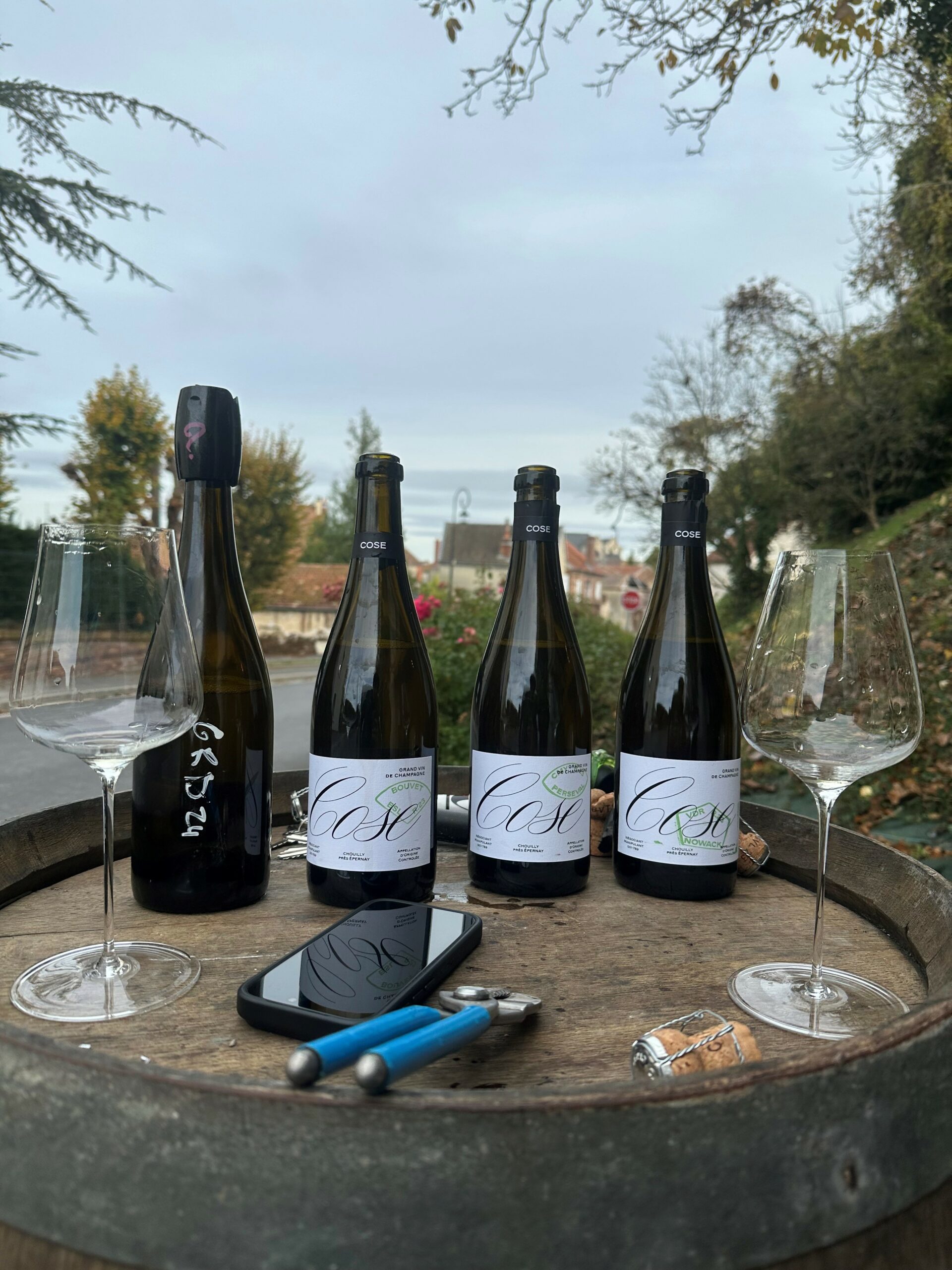
Champagne Cose is a fascinating project started in 2021 by Gil Conjo, a Mexico-born enologist who has been working in Champagne since 2012, and Victor Allier, owner of Sacre Bistro and Sacre Burger, two important restaurants that are considered watering holes for many producers in Champagne.
Victor has two sisters, one of whom is married to the vigneron, Guillaume Doyard. It was at a birthday party for Victor’s brother-in-law that Champagne Cose was born. “We have quite a lot of friends in common,” says Gil. “When we met, we had similar ideas about Champagne and talked about the possibility of doing something together over some bottles, and we ended at 3 in the morning”.
The idea born that evening was simple – to create a micro-negociant that would allow Gil and Victor to purchase grapes each year from a different group of top-level producers with whom they have relationships. They would then vinify the wines themselves without preconceptions of how they should be or taste based on previous experiences (as the producers do). For the producers, this allows them to express their work in the vineyards with a different dialect since Conjo and Allier would be vinifying the grapes and expressing the sites in a very different way than the producers themselves. Gil and Victor introduced their project to growers they admired and were pleased to find a real openness to what they’re doing.
The name was selected with an intentionally abstract meaning: “We are both kind of outsiders, so neither of us wanted to put our surname on the bottle. We chose Cose (pronounced Cos), which comes from a very old French word meaning 'thing' or ‘object’, like Cosa, in Italian” Gil says. “It kind of doesn’t really have a meaning”.
“When we meet a grower that we’re interested in working with, we present the project, and if they’re interested, they take us to some plots to walk around and get the feeling of the place. Of course, the grower decides which plot to propose, but the choice is made without judgment of what has been made before. It’s a little bit freer.” Gil says. “We know how to use the tools, but you have to feel the raw material. For us, it is important that there is no pushing. We must trust the grower and not try to overcontrol everything. We can give some advice, but at the end of the day, they are doing this with their vision, which gives more diversity to the project. It’s done naturally, the decisions. They work the vineyard and choose the harvest date. It’s like a gift. Well, one that you have to pay for!’ Gill laughs.
At harvest, the growers let Gil and Victor know a few days before picking. The fruit is then pressed according to each producer's own philosophy, with no instructions or interference. The only thing that the Cose partners ask is that no sulfur be added at the press or to the juice. Gil and Victor then pick up the juice, without any settling, and bring it back to their winery in Chouilly. The space is small, a true garagiste winery, stacked floor to ceiling with used barrels from their friends at Champagne Jacques Selosse. Selosse refreshes about 30% of their barrels each year, so Cose has a range of different coopers and ages of barrels to work with. Fermentation occurs naturally in wood, and the wine is bottled in August, just before the next harvest, a relatively long elevage for Champagne.
In the cellar, “we try to match the personality of the wine to the personality of the barrel. That’s important. We fill the barrels first and let fermentation happen spontaneously, but we also use a pied de cuve to ensure that the fermentation ends. We have lots of nourishment from the yeast with a lot of solids when we bottle, but we want the wine dry.” Secondary fermentation is done agrafe, under cork, and the small production is disgorged manually.
The wines are produced in very small quantities, and they are all superb and full of personality. The first release, mainly sold in Europe, was three wines: a Chardonnay from Roland Champion in Chouilly, a Pinot Noir from Domaine de Bichery in the Aube, and a Pinot Meunier from Bryan Marx of Marx-Coutelas in the Marne. Subsequent releases included Pinot Meunier from Flavien Nowack in the Marne and Thomas Perseval in the Montagne, as well as Chardonnay from Antoine Bouvet in the Grande Vallée. “For us, the friendship, connection, and relationship with the grower is most important. They are signing their personality into the grapes. For us, we take a more humble position. It’s a nourishing project at the end of the day; you don’t choose that much. The winery is a kind of metaphor for life.”
These are thrilling wines that offer something truly unique and new with each release.